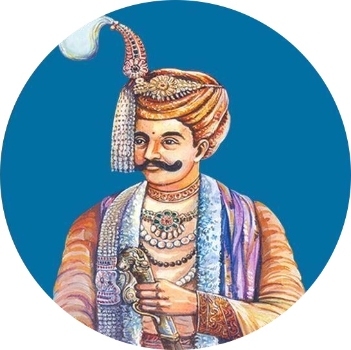
Aurangzeb Alamgir, the sixth Mughal emperor,
reigned over one of the most expansive empires in Indian history. His reign
(1658-1707) is often characterized by his rigorous administration and his
staunch adherence to Islamic orthodoxy. One of the most significant aspects of
his rule was his policy towards the Deccan, a region in southern India that
became central to his ambitions and, ultimately, to his downfall.
The Deccan
Plateau, with its strategic position and fertile lands, was a coveted prize
for the Mughal Empire. By the mid-17th century, the Deccan had become a region
of significant political fragmentation. The Mughal Empire, having consolidated
its power in the northern and central parts of India, turned its attention to
the Deccan sultanates: Bijapur, Golconda, and their smaller allies. Aurangzeb's
policy towards these sultanates was driven by a combination of strategic,
economic, and ideological motivations.
Aurangzeb's Deccan policy was initially strategic.
The Deccan region was crucial for controlling the southern trade routes and
securing the empire’s southern frontier. By annexing the Deccan, Aurangzeb
aimed to consolidate Mughal power and integrate the region’s wealth and
resources into the empire. This would also prevent any foreign powers, like the
Portuguese and the English, from gaining a foothold in the region, which was
vital for maintaining Mughal dominance over the subcontinent.
Economically, the Deccan was rich in resources,
including fertile lands and strategic trade routes. Aurangzeb envisioned that
controlling this region would augment the empire's revenue and military
strength. The Deccan's wealth could support the empire's vast administrative
and military apparatus, which was crucial for maintaining the Mughal Empire's
extensive territory.
Aurangzeb’s Deccan
policy was also influenced by his personal ideology and religious
convictions. Unlike his predecessors, who were relatively tolerant of other
religions, Aurangzeb pursued a more orthodox and conservative interpretation of
Islam. He believed in expanding the influence of Islam and viewed the Deccan
sultanates, which were predominantly Muslim but not in line with his version of
Islam, as opportunities to impose his religious ideals.
This ideological commitment led to increased
conflict with the Deccan sultanates. For instance, the prolonged siege of
Golconda and Bijapur were not merely military campaigns but also attempts to
assert religious orthodoxy and dominance. Aurangzeb’s actions, including the
demolition of temples and the imposition of the jizya tax on non-Muslims, were
part of his broader agenda to enforce Islamic principles.
Aurangzeb’s Deccan policy faced numerous challenges.
The region’s diverse and resilient local powers, including the Marathas led by
Shivaji Maharaj and his successors, presented significant resistance. The
Marathas were adept at guerilla warfare and managed to weaken Mughal control
over time. Additionally, the protracted wars drained the Mughal treasury and
overstretched its military resources.
Aurangzeb’s Deccan
policy was a complex interplay of strategic ambition, economic
considerations, and ideological fervor. While it aimed to strengthen the Mughal
Empire and integrate a crucial region, it also led to protracted conflicts and
significant strain on the empire’s resources. The policy highlighted the limits
of Aurangzeb’s vision and contributed to the eventual decline of the Mughal
Empire, illustrating the challenges of imperial expansion and the consequences
of ideological rigidity